
Vimodi | Best mobile presentation discussion app
  • About
  • Features
  • Support
  • Use Cases
  • Blog
  • Press

The Siren Song of Technology: Can Digital Interaction Replace Social Interaction?

12/12/2017

0 Comments

 
Picture
How often have you seen a couple at a restaurant engrossed in their phones instead of each other? Most of us agree that this occurs all too frequently. Indeed, you could easily believe that personal connections have become less valuable to us than digital ones. 

Ironically, it is precisely our need for constant personal interaction that has fueled digital interaction.  However, they are not the same and are definitely not interchangeable. On the one hand, we love technology—most of use could never be without our smart phones. On the other, we are wired to love tangible and physical interaction. For the joy of speaking to someone face to face, anticipating the curve of their lips as they begin to smile, and being washed over by the warmth of their voice, a smiley face just isn’t going to cut it.

Both personal interaction and digital interaction are necessary and important, but the key is knowing when to use each, and in particular how to resist the allure of digital when personal would be better and more fulfilling.

The Easy Temptation

The pull of technology today is in many ways no different than the lure of the Sirens in Homer’s epic poem, the Odyssey. The hero Odysseus sails home to Ithaca after the fall of Troy to reclaim his land and reunite with his family. Along his journey, he encounters the Sirens, whose song is so sweet that none can resist it: every previous sailor to hear the enchanting song immediately steered towards the Sirens, only to hit the rocks nearby and sink.

Odysseus knows that he wants to hear the song, but he also doesn’t want to crash the ship and fail in his quest. So, he literally puts himself “in a bind.” He has his crew tie him to the mast of the ship, and has the rest of the sailors fill their ears with beeswax, so that only he can hear the song, but he is tightly bound and cannot sink the ship.

By constraining himself this way, Odysseus actually achieves a better outcome. This tale from the Odyssey is an example of how behavioral economists approach “dynamic inconsistency,” the idea that our preferences may change over time in ways that directly conflict with previous desires. That is, I would like to have deeper engaging conversations with friends in person, but I know that when my phone vibrates I will immediately turn to the conversation my other friends are having on Twitter. I would like to have better relationships with my colleagues at work, but when faced with a choice between dropping by their office or shooting them an email, I’ll choose the latter. How to break the spell?
Breaking the Spell

Two modern artists have captured this sentiment directly in their work:  the enigmatic Banksy conveys this brilliantly in his new street art, “Mobile Lovers*,” and writer/director Gary Turk speaks with power about this in the moving short film, “Look Up*.” “Mobile Lovers” speaks for itself, and Turk’s video of a spoken word love story pleads with an online generation to “look up” from our personal devices long enough to seize real life in its full satisfaction. Both artists are getting plenty of airplay and online shares right now—“Look Up” is at forty million views and counting. Clearly the Siren call of digital is worrying us.  

Dont let your device dictate who you are

Sherry Turkle, MIT professor of social studies of science and technology, lamented the disconnectedness of society in her powerful TED talk "Connected but alone?" & her New York Times article, “The Flight From Conversation,” two years ago. She warned that we are sacrificing conversation for a connection and that our devices are becoming so powerful that they change not only what we do, but also who we are.

Overindulging on digital turns us into robots, and it can be a slippery slope—the only limit to indefinite computer and device use is mental exhaustion. In his TEDx talk, Professor Luis Almeida interviews students who exhibit symptoms of “technology numbness” from logging long hours online without any breaks.

Strike a balance between digital literacies and interpersonal conversation

However, quitting cold turkey isn’t just going to work—it’s not realistic. We believe that technology that enhances personal interactions and that helps us switch back and forth between personal and digital is the real answer.

High school teacher Paul Barnwell of The Atlantic has this exact kind of approach in mind and applies it in his classroom. He asks, “What if we focused on sharpening students’ ability to move back and forth between the digital and real world?” If the march of digital interaction is inevitable, breaking the spell means not simply telling students to avoid digital interactions but teaching them to know when digital or personal are the right way to communicate. 

“We can use technology to encourage students to strike a balance between digital literacies and interpersonal conversation,” argues Barnwell. He notes that students tend to take conversations more seriously when recorded and that smartphones make excellent recording devices. 

Without a doubt, digital interaction is here to stay and clearly some types of communication are better on our “always-on” mobile devices, like where to meet or how to get there. But when we use the same technology for more complex items it fails us. Indeed, there is real joy and richness in connecting in person. One can only guess what personal connection Banksy’s mobile lovers are missing by staying digitally connected. 

Photo* - "Mobile Lovers," by Banksy
Video* - “Look Up,” by Gary Turk

At Vimodi, we are developing technology that helps users have a more engaging, responsive and effective visual discussions and dialogues. Vimodi enables visual mobile discussions for better engagement, motivation, and creativity in meetings and daily communication. Try Vimodi App for free.
0 Comments

How to Get Buy-In for New Ideas

11/14/2017

1 Comment

 
Picture
What can we learn from French chefs about getting buy-in for innovative ideas? Actually, quite a lot.

Pan-fried salmon is nearly a staple in most restaurants today. In fact, the dish—pan-fried salmon with sorrel sauce—created a hotbed of controversy in French cooking in the 1970s when first served by the legendary Troisgros brothers at their Michelin-starred restaurant.

During that time, a group of French chefs including the Troisgros brothers began a period of category crossing that led to the creation of the now widely popular “nouvelle” cuisine. How did they do it? By connecting elements from classical cuisine with the new cooking styles to establish a new gastronomic identity.

It wasn’t easy—initially, the chefs that blended elements from classical and nouvelle cuisine were rated more harshly by Guide Michelin critics. However, eventually critics accepted this gastronomic “bricolage” and new gastronomic style was born.

How bricolage helps buy-in

A team of researchers from Stanford, EM Lyon, HEC Paris, led by Hayagreeva Rao found that successful chefs were not the ones that simply produced dishes in both categories, but those that selectively integrated elements of the new style into their old style cuisine. By building off established techniques, the chefs were able to use the existing approach to entice diners to the new cuisine.

Celebrated chef and restaurateur Daniel Boloud and culinary guru Dorie Greenspan write that the Troisgros’ salmon and sorrel dish became a touchstone that truly marked that passage from classical to nouvelle cuisine. They argue that the manner in which the brothers chose elements from classical cooking and blended them in new ways was the key to their success. They explain, “The components of the dish were not the newsmakers—they’d been used singly and in combination for years by chefs in France.” Building on the classical foundation and innovating from it, “It was the way in which the salmon was cooked and the manner in which the plate was arranged that rocked the culinary establishment.”

Bizarre (and connected) is better

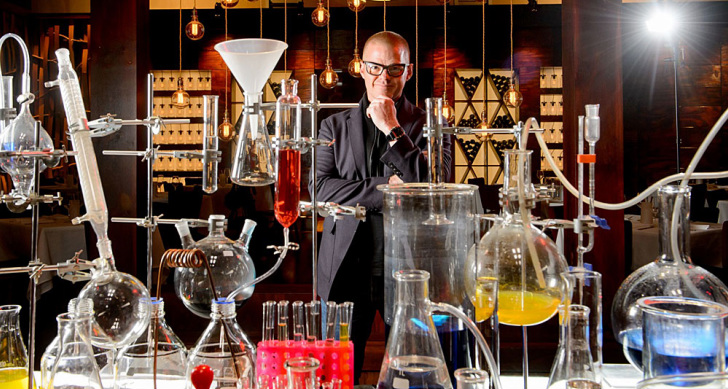
The idea that customers and critics will be more accepting of new ideas if they are linked to familiar ones has been embraced by British chef, Heston Blumenthal. His innovative combinations like salmon and licorice have earned him accolades – and three Michelin stars - for his restaurant, The Fat Duck, where the kitchen looks like a chemistry lab. Blumenthal’s take on modern cuisine is built on the idea that novel, atypical category combinations can work, especially when they are connected to things that are familiar (both salmon and licorice have roots in Dutch cuisine).

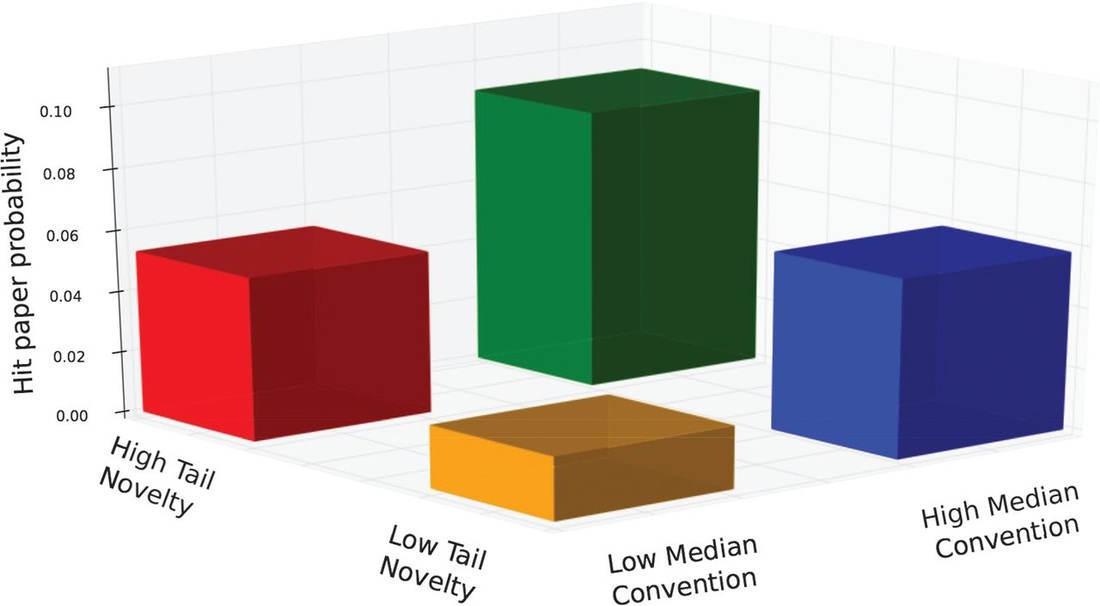
In research sponsored by Northwestern University Institute on Complex Systems Brian Uzzi and his team analyzed 17.9 million academic papers to uncover what kind of work leads to the greatest scientific impact, and found that the most impactful work had both high novelty and conventionality. In other words, it made unusual combinations of ideas but was also critically grounded in the foundations of existing work. 
Picture
This has important implications for getting buy-in of new ideas. For an innovative, groundbreaking idea to be accepted, it’s essential to present the idea in the context of prior work. By linking the old ideas to new ones, audiences will be more receptive and have a better understanding of the new concept. Without the connections, a new idea is likely to be rejected out of hand. 

Our love-hate relationship with creative ideas

Why does this occur? Surprisingly, research at Wharton, UNC, Cornell by Jennifer S. Mueller and colleagues, has shown that human beings actually have a subtle bias against creativity. Somewhat paradoxically, even when people say that they desire creative, exciting ideas, in fact, they tend to shy away from them especially faced with uncertainty. In a recent research study, study subjects who believed they were open to creative ideas evaluated creative ideas negatively if they were put in an uncertain situation.  

What results like these teach us is that people do have a strong desire for creativity and innovation. However, in order to gain their buy-in for novel ideas, it’s important to connect the new ideas to the accepted ones when presenting them. By linking the old with the new, innovations don’t appear as a fad or a flash in the pan (no pun intended), but can be understood as important building blocks in the continuing progress of our ideas.  

Creativity is connecting things

Steve Jobs, in describing the generation of novel ideas, is famously quoted as saying, "Creativity is just connecting things." The lessons from the French chefs and the rise of nouvelle cuisine tell us that generating the ideas is only part of the innovation process. We need to communicate the connections, not only the ideas, for others to accept them. 

Photo* – Edison Light Globes

At Vimodi, we are developing technology that helps users have a more engaging, responsive and effective visual discussions and dialogues. Vimodi enables visual mobile discussions for better engagement, motivation, and creativity in meetings and daily communication. Try Vimodi App.
1 Comment

Is the Pope More Tech-Savvy than the President of France

10/11/2017

0 Comments

 
Picture
How much technology is too much? French president François Hollande would argue that even a little can be distracting. Last week, the president made a move to ban the use of all mobile phones in cabinet meetings. A spokesman for Hollande indicated that the president wanted to increase the focus and attention staff members paid in meetings.

What’s the reasoning behind getting rid of technology in meetings?

Leaders like Hollande believe that technology can be constraining, and they are not totally wrong. Hollande’s spokesman explains, “Each of us will now have to talk and listen to what is to what is said and will no longer be able to tap away at this magnificent tool.”

Let’s break this down—the statement does a couple things. Hollande’s spokesman both identifies a benefit and a problem to using technology in political meetings. On the one hand, having mobile devices on hand can be distracting and can detract from focus and effort on the task at hand. On the other, having access to powerful tools such as the Internet and apps that allow for real time updating of information can be an invaluable and “magnificent” boost to production.

You’re not living in the 19th century

So why throw out the baby with the bathwater? During the industrialization of Great Britain in the early 1800s, a group of disgruntled textile workers called the Luddites engaged in a series of protests aimed at rebelling against the technological tide of the times. Their method? “Machine breaking”: Destroy every piece of technical machinery they could find in order to halt innovation and break free of the Industrial Revolution. Even if you’re not a historical scholar, it should be clear who won out in the end.

The Luddites unilaterally rebelled against crucial technological developments of their time because they were unable to harness the power of new innovations and separate the good from the bad. Because they were unable to adopt and adapt, they soon became irrelevant.

Don’t be a machine breaker

While Hollande may accomplish some gain in focus by banning phones, he’s also “broken” any effectiveness this technology may have in his meetings. This kind of unilateral approach is a copout. The solution is not to ban mobile devices, slide presentations, or any other kind of technology, but to figure out how to use them to increase engagement in meetings. Rather than simply viewing them as new-fangled distractions, the onus is on effective leaders and communicators to figure out how to adapt and adopt new technological tools to stay on the cutting edge.

Pope Francis seems to have figured this out. Only ordained in March 2013, he already has 463,000 Facebook likes and 160,000 Instagram followers. He tweets regularly to his 3.5 million followers, and stresses the importance of taking an active role in using technology to bring ideas and people together, explaining, “It is not enough to be passerby on the digital highways, simply ‘connected’; connections need to grow into true encounters.” Pope Francis argues that the current “revolution” in communications media will facilitate the diffusion of ideas with personal engagement like never before.

It is a poor carpenter who blames his tools

With all of the technology available to use for communicating ideas, we are selling ourselves short by taking a canned, impersonal approach to delivering information. When these go wrong, it is unfair to blame the technology itself—communicators must take an active role in managing the tools available. Don’t shun technology. Instead, think about how to use it to increase the engagement of your audience.

Hollande’s solution is short sighted. Sure, he gets his cabinet ministers to stop fiddling with their mobile devices in meetings. But he also is missing out on the potential that mobile technology could have for increasing engagement in discussions. The challenge is not to avoid mobile technology but to design apps that make it work the way we need it to.

Photo* - BBC News 

At Vimodi, we are developing technology that helps users have a more engaging, responsive and effective visual discussions and dialogues. Vimodi enables visual mobile discussions for better engagement, motivation, and creativity in meetings and daily communication. Try Vimodi App.
0 Comments

Why Over-focusing Kills Creativity

7/19/2017

1 Comment

 
Picture
How to find creative solutions to new problems? New research suggests that we actually do this better when we focus less. Taking a broader approach to problem solving can help with combining novel ideas that have a huge impact.

The grasshopper experiment

In a classic episode of “The Big Bang Theory,” Raj Koothrappali realizes he can only talk to girls if he drinks. He consumes round after round of grasshopper cocktails and becomes more talkative after each one. Though not immediately obvious, the reason why cocktails helped Raj actually offers insight into finding creative solutions to new problems.

Researchers at the University of Illinois Chicago  recently conducted a study  in which participants watched a short movie and then afterward were given a creative word association task. Half just watched the film, and the other half watched the film while drinking an alcoholic cocktail. While both groups performed about equally well before the film, afterward the group that was given the cocktail performed significantly better on the creative task—they not only completed the problem more quickly, but were also more accurate.

“Tricking” your brain

Psychology has taught us that our brains are complicated pattern recognizers. In fact, this is how we learn language at a very young age (8 months!). By recognizing the relative probabilities of hearing one kind of speech sound paired with the next, we keep a record of these patterns and develop an intuitive sense for where words end and begin. New York Times bestselling author Ray Kurzweil agrees, and explains in his book, How to Create a Mind, that the brain uses a pattern of “search parameters” to keep an inventory of ideas and the relationships between them.

Usually, the brain searches out local networks—these are ideas that are already connected in a familiar way. This is the default process, and how our brains operate when we apply focus. This means that we actually have a natural bias against innovation. In order to overcome this, we need to trick the brain into applying a broader approach that allows for creating new connections and combining novel ideas: in other words, searching in more far-flung regions of the brain.

Cocktails help with creativity because alcohol broadens the focus of attention just enough for us to connect more distantly related ideas. The same lowered inhibition that helped Raj talk to girls also helps with connecting distant ideas to come up with novel combinations.

Don’t run to the bar just yet

There’s another effect at work here too. The low levels of alcohol consumed by the participants also helped to relax their mood. Researchers Mark Beeman and Karuna Subramaniam of Northwestern University found that participants who watched a short comedy routine were able to solve word puzzles requiring creativity with much more intuitive insight.

Beeman explains, “What we think is happening is that the humor, this positive mood, is lowering the brain’s threshold for detecting weaker or more remote connections.” These weaker and more remote connections are what unlock the brain’s creative ability to solve puzzles with novel solutions and apply new innovations to previously unthought-of areas.

Put on a smile

There are insights from neuroscience to back this up too. When we’re more stressed, this activates a flight-or-fight response within the brain. Formally called the Reticular Activating System, this shifts control of the brain to from the cerebral cortex to the limbic system. The limbic system is great for survival—it helps us make instinctive decisions under pressure. At the same time, however, it deprioritizes the need for creativity and stays away from novelty.

When we relax, the Reticular Activating System toggles control back to the cerebral cortex. Here, the brain is free to engage in creative and nuanced thinking, the kind that results from more symbolic thinking. Some research has suggested that many forms of “writer’s block” are actually a result of these “limbic takeovers” in the brain.

Practice makes perfect

Creativity doesn’t happen by accident—it’s a skill we can hone and develop through training our brains to think a certain way. In a business setting, for example, discussing potential product innovations with your team, how can you get your team to "focus less" to be "more creative"?

Start with these three ideas to get in the habit of thinking creatively:

Inject humor: Depending on your own comedic abilities, opening with a joke can be dangerous. But let someone else do the heavy lifting for you: play a quick YouTube clip or share a funny blog post to lighten the mood before you get started.

Practice connecting distant ideas: Bestselling author Steven Kotler suggests reading two articles at random from your favorite newspaper or online news source. Then, do an exercise writing a few sentences about how the articles could possibly relate to one another. This trains the brain to broaden the “search parameters” it has in its repertoire.

Have a happy hour: Sometimes the Raj route is best. Institute a Friday evening happy hour after work, and facilitate interactions with your team. By combining casual drinks with positive mood (who isn’t in a good mood by the end of the workday Friday?), you’re at the intersection where great innovative ideas are born.

Photo* - Big Bang Theory Wiki

At Vimodi, we are developing technology that helps users have a more engaging, responsive and effective visual discussions and dialogues. Vimodi enables visual mobile discussions for better engagement, motivation, and creativity in meetings and daily communication. Try Vimodi App.
1 Comment

Why the Bar Test is better than the Grandmother Test for your next Sales Pitch

6/14/2017

1 Comment

 
Picture
You might be familiar with the well-known “Grandmother Test” for determining how user-friendly and easy to understand an idea is. Sit down your grandmother, grandfather, or another family member who is completely unfamiliar with the subject area you’re working on, give them your best pitch, and see if they get the basic idea.

Clarity is a good start, but its not enough. The main point of the test is to make sure that people will understand what you’re talking about. But, your grandmother will usually try to support you and listen no matter what you have to say. Imagine giving the same talk to someone you just met in a bar—would they get bored and walk away?

IDEO Project Lead Nicole Kahn has a solution for transforming presentations into stories that captivate, and she calls it the “Bar Test.”

"Bars are friendly, social places, sure, but something really important happens when you’re at a bar,” explains Kahn. “You use really direct language. You make sure that what you’re saying is entertaining and engaging. You don’t quote tons of data. You don’t use overly corporate language — except maybe in air quotes.”

Before giving a presentation, Kahn and her IDEO colleagues run the Bar Test by giving their presentations to friends or co-workers who are unfamiliar with the subject area. "We grab a colleague …and buy them a beer or a coffee and spend 15 minutes to see if they understand the point of the presentation."

15 minutes could save you.....

Kahn recommends taking 15 minutes to see if they understand the point of the presentation. “We look for when they lean in, or when they look away or reach for their phone. We look for nods and ‘uh-huhs’—we look for what surprises and delights. That’s how we figure out what’s sticky and resonating.”

Why so short? Using only 15 minutes has a dual-pronged effect. First, it forces the story to be succinct. You must get to the point quickly, and also make the story pop. This is helpful, because it compels us to sift through what’s really important for conveying an idea. You might have 5 or 8 slides relating to an idea, but are they all really necessary for describing the heart of your idea?

15 minutes also keeps the investment low. That’s the beauty of the Bar test: it allows for a low-cost trial and error approach. If your first attempt doesn’t get a great response, that’s all right—spend your next 15-minute session using a new approach. The key is to be flexible, and don’t get stuck on one idea.

Passing the Bar test

Kahn stresses three essential strategies

Develop a cohesive “through-line”: What is the main takeaway? Make sure everything in your presentation builds up to and reinforces the underlying “big idea.”

Use compelling anecdotes: These little narratives are what bring your ideas to life and make them personal. Kahn suggests using anecdotes that “provide a tactile sense of experience, take your audience on a journey, and create drama.”

Incorporate personal reflection: Don’t be a robot. Think strategically about moments when you can use your own personal experiences and feelings. These can help cue your audience to react and feel what you want them to during the story.

More bar tricks

Use questions to engage others. Arthur Palac, formerly one of Miller Beers' top ranked salespeople, describes the importance of bolstering your message by asking reinforcing questions such as “Have you ever felt that before?” or “Has something like this ever happened to you?” According to Palac, "If you’ve been talking for over 20 minutes and you haven’t asked a single question of the audience, you’ve lost them."  

Use visuals. Visuals don’t just provide another level of information you can use to deliver your ideas, they actually change the dynamics of the entire presentation. Kahn explains, “When you have visuals on the screen and not a lot of words, you make people dependent on you as the presenter to know what’s going on. You have the authority in the room. The slides do not.” Text-filled slides usurp your power to control the room, craft your personal narrative, and hold the audience’s attention.

The next time you need to get buy-in for an idea or make a sales pitch to a customer give the Bar Test a try. No offense to grandma of course.

Photo* - Daily Star Sunday

At Vimodi, we are developing technology that helps users have a more engaging, responsive and effective visual discussions and dialogues. Vimodi enables visual mobile discussions for better engagement, motivation, and creativity in meetings and daily communication. Try Vimodi App.
1 Comment

Why Bullet Points and Build Effects Kill Communication

5/17/2017

0 Comments

 
Picture
You wouldn’t try to multitask while giving a talk, so why would you make your audience? Nancy Duarte explains in her book, HBR Guide to Persuasive Presentations, that using software to communicate is not an evil of itself. However, using uninspired bullet point lists and cluttered build effects can stop effective communication in its tracks. Applying a design-based approach to sharpen the focus of ideas and communicate ideas in context is the answer.

For each visual used, Duarte asks: “Can I immediately pick out the key piece of information on this slide?” Slides that are too busy with words or even unnecessary graphics detract from the critical message. Passing the test requires bringing a design focus to bear on building effective slides. Use restraint, and make sure that every additional element contributes directly to the critical information. For example, Duarte asks, “Does the audience need to see your logo on each slide to remember who you work for?” Even accents that may appear subtle and innocuous can be distracting and make it difficult for the audience to focus on what matters.
Duarte recommends applying these five basic design principles to each visual you create:

Flow: structure slides to direct the transition of people’s attention to what is most important

Contrast: juxtapose visual elements to draw striking comparisons that make your point even more obvious

White space: just as a well placed pause between words can speak volumes, managing blank space instead of trying to fill it can isolate and sharpen the focus of important points

Hierarchy: treat your slide like the page of a comic book—think about where the viewer’s attention will start and end to prioritize the information they receive

Unity: maintain harmony in text style, themes, and image types so that each slide feels like a different part of the same body

Using a design focus greatly increases the effectiveness of communication tools. Be frugal with each element you add to a slide so that you get the most out of every visual cue. 

Lessons from neurology have long highlighted the importance of visual processing. However, the less the viewer has to sift through to get to the critical information, the more effective the communication will be. 

Ideas need to be shown in context. As social media guru Gary Vaynerchuk once stated famously, “If content is king, context is god.” The value here is that communication is most effective when it builds on itself. Structure ideas so that they flow into each other in a way that tells a story—without context, numbers and graphics do not add anything on their own. 

*Photo - Effective Public Speaking Tips

At Vimodi, we are developing technology that helps users have a more engaging, responsive and effective visual discussions and dialogues. Vimodi enables visual mobile discussions for better engagement, motivation, and creativity in meetings and daily communication. Try Vimodi App.
0 Comments
<<Previous

    Categories

    All
    Creativity
    Entrepreunership
    Funding
    Innovation
    Marketing
    Nonlinear
    PowerPoint
    Presentations
    Sales Interaction
    Visual Dialog

    Picture
Home    About    Features    Support    Use Cases    Blog    Press    Contact        
©2018 Vimodi | Presentation Discussion App for Meetings provided by tabloMedia Inc.